

Quick Summary
To display large linocut prints well, measure the image and full sheet, mount the paper on acid-free board using archival hinges at the top edge, and frame it with UV-filtering glazing. Hang it away from direct sunlight, using hardware rated for the whole frame's weight.
- Measure the image area and full paper size, noting border width on each side.
- Hinge the print with archival tape at the top edge only, never taping all four sides.
- Use two top-corner hinges, plus one top-centre hinge on very large prints.
- Choose UV-filtering acrylic or glass, weighing acrylic as the lighter option for big frames.
- Keep the print out of direct sunlight, away from radiators, and in stable humidity.
Table of Contents
- What You Need to Display a Large Linocut Print
- Step 1: Check the Print Size and Choose Your Display Dimensions
- Step 2: Mount the Print Without Damaging It
- Step 3: Frame and Glaze for Protection and Presentation
- Protecting Your Linocut From Fading and Final Hanging Tips
- Frequently Asked Questions
What You Need to Display a Large Linocut Print
Last Updated: November 17, 2026
Large linocut prints are bold, detailed, and built to be seen. Large linocut prints often carry fine carving and rich ink layers, so showing one off well matters. This guide walks you through sizing, mounting, framing, and protecting a big linocut so it looks as good on your wall as it did on the press.

Most displays go wrong before a single nail is hammered. People buy a frame that is too small, flatten the paper with tape, or hang the print where sunlight hits it all day. A little planning avoids all three problems.
Before you start, gather a few basic supplies:
- A measuring tape and pencil
- Acid-free mounting board or backing board
- Archival-safe hinging tape (never standard clear tape)
- A bone folder for smoothing paper
- Cotton gloves to keep oils off the surface
- A frame with UV-filtering glazing
- Level, picture hanging hardware, and wall anchors rated for the weight
Acid-free and archival materials matter because ordinary card and tape can yellow and stain paper over time.
Watch out: Avoid household glue, masking tape, or photo-corner stickers directly on the print.
Step 1: Check the Print Size and Choose Your Display Dimensions
Start by measuring the print itself, not the paper it sits on. Linocut prints often have a border of blank paper around the image, so the image size and the sheet size can differ. Measure both and write them down.
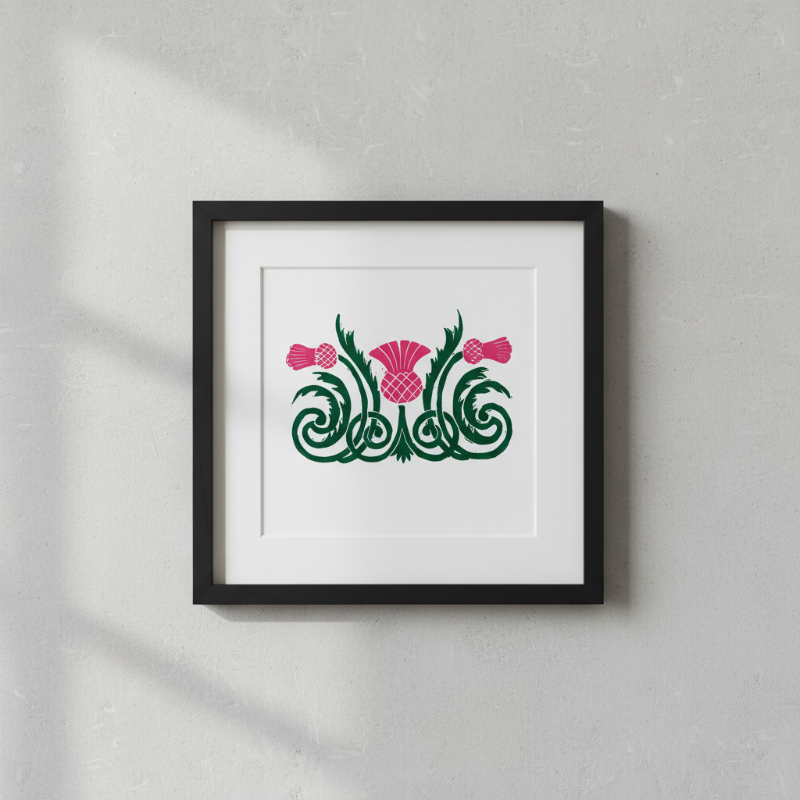
Knowing the image size helps you pick the right frame. A frame that sits just inside the image edge can cut off details, while a frame with too much mat can make a large piece feel small. Look at how much paper surrounds the carved image before you decide.
Decide where the print will hang next. Measure the wall space and mark the outer edges with painter's tape. Lay the tape out at the size of your frame and step back. This simple test shows you whether the piece will feel balanced above a sofa, beside a doorway, or in a hallway.
- Measure the image area and the full paper size
- Note any border width on each side
- Mark the frame footprint on the wall with painter's tape
- Check furniture and ceiling clearance before you commit
If you are unsure about a size, ask the shop before you buy a frame. Plenty of buyers find it easier to measure first and choose a frame second.
Step 2: Mount the Print Without Damaging It
Mounting protects the print and keeps it flat, but on a large linocut the paper's own weight works against you.
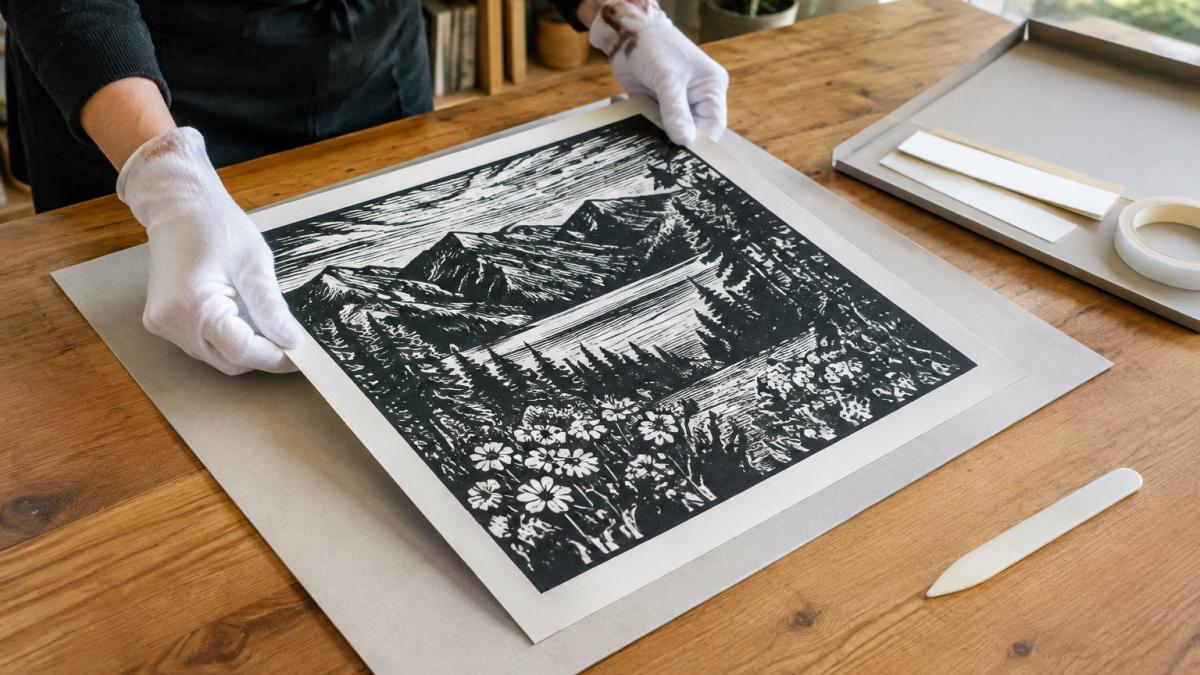
Put on cotton gloves, then lay the print face up on a clean, flat surface. Place it on an acid-free backing board, centered, with the border evenly spaced on each side. For oversized prints, a rigid backing board is generally the more practical choice.
Hinging is the part most people get wrong. Use archival hinging tape, not standard clear tape, and make the hinges from the back of the print rather than the front.
Work slowly and avoid pressing hard on the carved lines, since heavy pressure can flatten fine detail. If the print has a wide border, keep the hinges within the border and never let tape touch the image area.
Watch out: Taping all four edges to the board. Paper swells and shrinks with humidity, and fully fixed edges can warp the sheet or tear at the tape line. Hinging from the top keeps the print flat while letting it move.
For a large print, two people make this easier. One holds the print while the other places the board. Take your time here, because a shifted print is hard to fix once the tape sticks.
The mounting steps come down to a few key choices, summarised below.
Mounting choice |
Recommended |
Avoid |
|---|---|---|
Backing board |
Acid-free, rigid board |
Standard card |
Hinging tape |
Archival hinging tape |
Standard clear tape |
Hinge pattern |
T-hinges at the top edge |
Taping all four edges |
Hinge placement |
Two top corners, one top centre on large prints |
Any tape touching the image area |
Handling |
Cotton gloves, two people for large prints |
Bare hands on the surface |
Step 3: Frame and Glaze for Protection and Presentation
A good frame does two jobs: it holds the print and it shields it from light, dust, and handling. On a large linocut, the frame also has to carry real weight, and that changes almost every choice you make.
Choose a frame with a backing that is not in direct contact with the paper, and use a spacer or mat so the glazing never touches the print. A mat keeps the glazing off the surface and adds visual breathing room, but on an oversized piece a wide mat can push the outer frame size up fast.
For glazing, UV-filtering acrylic or glass helps slow fading from sunlight. Acrylic is lighter and safer for large sizes, but it scratches more easily than glass. Glass is heavier and can be risky on big frames, so check the weight before you hang it. Acrylic is often a lighter option for very large frames.
Frame weight is the hidden problem. A large frame with glass can weigh far more than the print itself, and the hanging hardware has to be rated for the whole assembly, not just the artwork. Before you buy, weigh the finished frame or ask the framer for an estimate, then match your wall anchors and hanging hardware to that number.
Framing ideas that suit large linocuts include:
- A simple black or dark wood frame for a moody, gothic look
- A wide off-white mat to draw the eye to carved detail
- A thin metal frame for a modern room with a historic print
- A deep shadow box if the print sits on a board with a border
Ask the framer to check that the frame is square and that the mat is acid-free. Good framers handle large prints every day, so do not be shy about asking questions.
Protecting Your Linocut From Fading and Final Hanging Tips
Once the print is framed, keep it away from direct sunlight and heat sources such as radiators and fireplaces. Pick a wall where sun does not hit the glazing for long stretches each day. Rotating the print is not a fix for fading, so placement matters most.
Keep humidity steady. Bathrooms, kitchens, and damp basements can cause warping and mold (the EPA). A room with stable temperature and moderate humidity is the safest choice.
Hang the frame with hardware rated for well over its weight. Mount a hanging wire or D-rings on the back of the frame, then use wall anchors into studs when possible. Hang the piece so the center sits at roughly eye level, and check it with a level before you step back.
Clean the glazing with a soft microfiber cloth and a small amount of glass cleaner sprayed onto the cloth, not the glass. Never spray liquid directly onto the frame, since moisture can seep behind the glazing.
With careful sizing, gentle mounting, and a protective frame, a large linocut can hang beautifully for years. Modern Medieval Press designs its prints to reward this kind of care, and a well-displayed piece becomes a true centerpiece in your room. Browse the Modern Medieval Press collection to find a linocut that suits your space.
Frequently Asked Questions
How do you hang a large linocut print without damaging it?
Use a hanging system rated for the full weight of the framed piece, such as D-rings with braided wire or a picture rail hook, rather than a single small nail. Locate the wall studs when possible, and attach hardware to the frame, not to the print. Keep the artwork away from direct sunlight and heat sources such as radiators, and check the hardware every few months. For very large or heavy pieces, a second person should help you level and position the frame before you fully release the weight onto the hanger.
Should a linocut print be mounted before framing?
Mounting is recommended for most linocut prints, especially those on thin or textured paper that can buckle or wrinkle in a frame. Use acid-free hinging tape or corner mounts on a conservation-grade backing board so the print can expand and contract with humidity without being glued directly. Avoid permanent adhesives and dry-mount tissue, which can be difficult to reverse. Pair the mount with a mat that leaves a border, so the image is never pressed against the glass.
How do you choose a frame size for a large linocut print?
Measure the sheet of paper, not just the carved image, because many linocuts have a margin around the image. Add a mat border of several inches on each side for a balanced presentation, and select a frame sized to the mat rather than the paper. Consider the wall space and surrounding furniture before buying, and sketch the dimensions on painter's tape to test scale. Prices for custom framing vary by size, glazing and materials, so request an itemized quote from a local framer or check the Modern Medieval Press website for current options.
How do you protect a linocut print from fading?
Light is the main cause of fading, so hang prints out of direct sunlight and choose UV-filtering glazing such as acrylic or conservation glass. Keep the room at a stable temperature and moderate humidity, and avoid bathrooms or kitchens where moisture is high. Store unframed prints flat between acid-free tissue in a dark, dry place. Rotating displayed artwork occasionally also reduces the cumulative light exposure any single piece receives over the years.
