

Quick Summary
Start with one legend you already love, then choose two or three motifs from medieval folklore themes, such as dragons, castles or manuscript borders. Build a four or five color palette around deep earthy tones and add one soft neutral.
- Pick one story first; a single legend gives the room a clear theme.
- Limit your palette to four or five main colors and use the darkest shade on the largest surface.
- Choose one strong motif for small rooms and two or three for larger rooms.
- Hang a bedroom print about 6 to 8 inches above the headboard, roughly two-thirds of its width.
- Use removable hooks rated for the frame's weight, and a second strip for anything heavy.
Table of Contents
- Choosing a Folklore Story to Build Your Room Around
- Creating a Medieval-Inspired Home Decor Palette
- Building a Castlecore Interior Design Plan Room by Room
- Folklore Decorating Ideas on Any Budget and Lease
- Booking Your First Folklore Print or Starting Your Collection
- Frequently Asked Questions
Choosing a Folklore Story to Build Your Room Around
Start with one story, not a pile of inspiration photos. A single legend gives your room a clear theme, and every choice after that becomes easier. Modern Medieval Press builds its collection around medieval folklore themes, marginalia and dragon lore, so many of the ideas below come from that same well of stories.
Pick a story you already love. Dragons, moonlit castles, knights, and wandering spirits all work well. If you are unsure, ask yourself which tale you would happily reread on a rainy Sunday.
Picking motifs that fit your space
Once you have a story, pull out two or three visual motifs drawn from medieval folklore themes. Motifs keep the room cohesive without making it look like a theme park.
- Dragons: Coiled shapes, wings and scales work well in prints and bookends.
- Castles and towers: Arched windows and stone textures suggest a fortress.
- Moons and stars: Night imagery adds a quiet, atmospheric note.
Choose motifs that suit the room's size. A small room looks best with one strong motif. A larger room can carry two or three.
Creating a Medieval-Inspired Home Decor Palette
A good palette makes folklore decor feel intentional. Start with deep, earthy colors such as oxblood, forest green, charcoal and aged gold.
Limit yourself to four or five main colors. Use the darkest shade on the largest surface, such as a wall or rug. Save the brightest accent, like gold or rust, for small objects.
Mix textures as well as colors. For guidance on blending old and new pieces, see how to mix vintage and modern decor. Rough wood, smooth stone, and soft wool add depth.
Building a Castlecore Interior Design Plan Room by Room
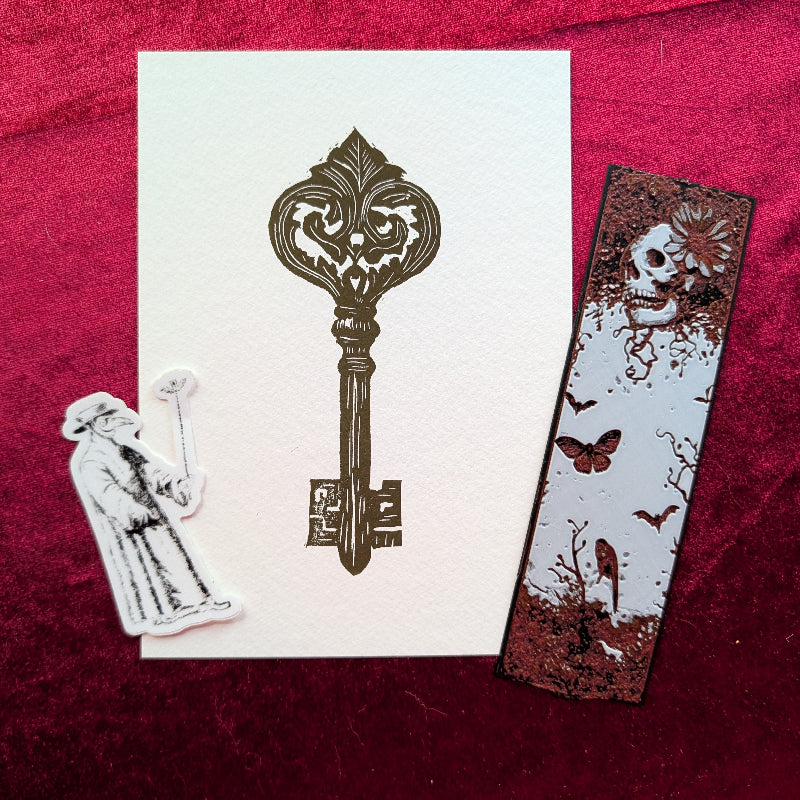
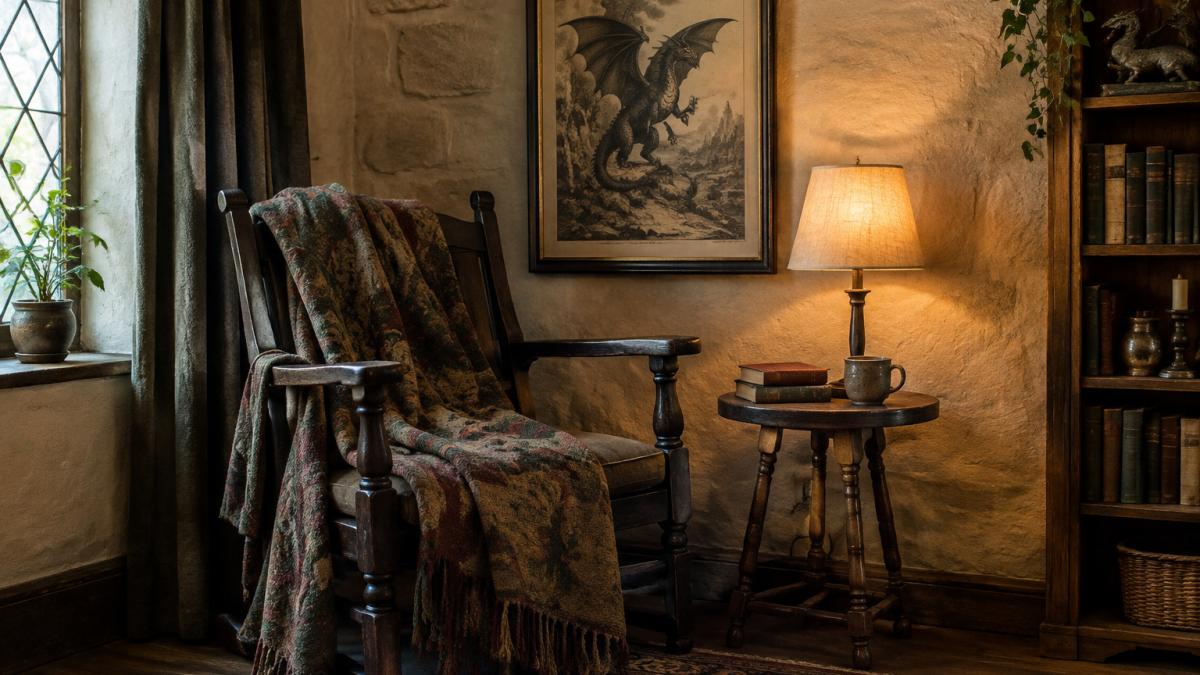
Castlecore works best when you plan each room for its job, then layer folklore on top of a functional layout. A useful sequence is to anchor the largest surface first, then the light, then the textiles, then the small objects. For reading corners, a bookish bundle supplies much of the nook decor in one purchase. Doing it in that order keeps you from buying accents before you know what the room needs.
The four-layer sequence for any room
- Anchor surface. Choose the wall color, the largest rug, or a single large textile. This sets the value range for everything else. In a rental, a washable low-pile rug in a deep tone does the same job as paint.
- Light. Decide where the warm pools of light will fall before you hang art. A floor lamp with a fabric shade, a plug-in wall sconce, or a battery-operated candle cluster each changes the mood more than any print.
- Textiles. Add one heavy layer (curtain, tapestry-style hanging, quilt) and one soft layer (throw, cushion) per seating or sleeping zone.
- Small objects. Books, candlesticks, bookends, framed prints. These are the last 10 percent of the room and the easiest to overbuy.
Living room
Start with the rug: an 8x10 or 9x12 in a deep tone under the seating group, leaving 12 to 18 inches of floor visible around the edges. Hang heavy curtains floor-to-ceiling on a rod mounted 2 to 4 inches below the ceiling line; this reads as castle-scale even in a standard-height room. Put the largest wall piece, a tapestry-style textile or a grouped print set, on the wall you face when you sit down, not behind the sofa.
Bedroom
The bed is the anchor. Layer a woven or quilted blanket at the foot, add two tall candlesticks or a plug-in sconce pair on the nightstands, and hang one dark, moody print centered above the headboard at roughly 6 to 8 inches above the frame. Keep the print width to about two-thirds of the headboard width so the wall does not feel top-heavy.
Entryway
Entryways are where folklore decor earns its keep because the space is small and the first impression is strong. A narrow bench (12 to 14 inches deep), a wall sconce or plug-in light, and one framed print at eye level, about 57 to 60 inches to the center of the frame, is enough. Add a shallow bowl or tray for keys so the bench stays usable.
Kitchen and dining area
Keep food surfaces clear. Use wooden platters and a simple iron candle holder on the table, and hang one textile or print on the wall farthest from the stove. If you want a banner or hanging, keep it at least 18 inches from any heat source and out of the splash zone.
Small spaces and rentals
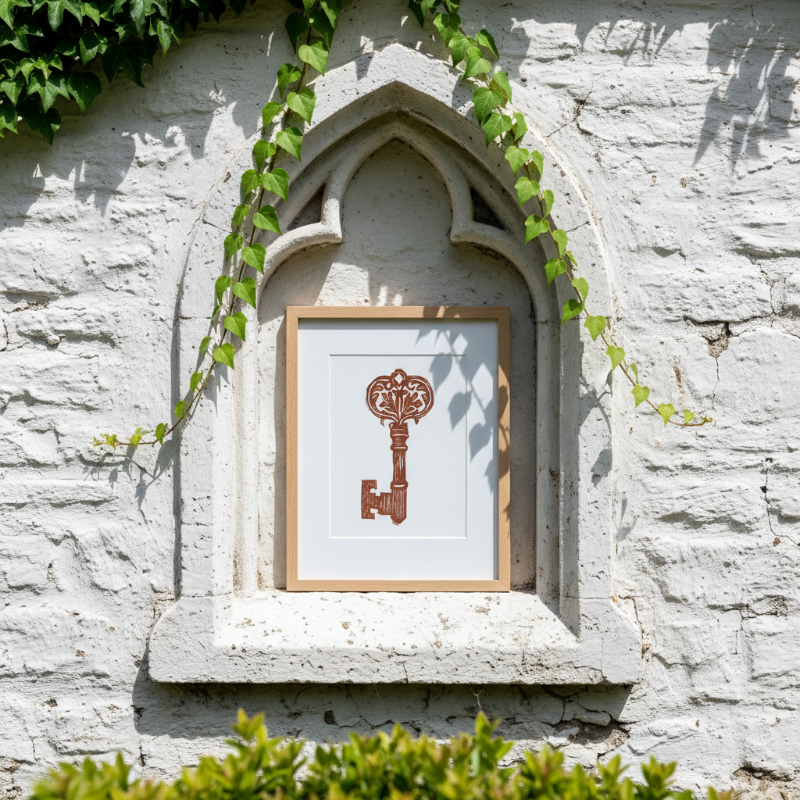
In a studio or small apartment, pick one motif and repeat it in three places rather than three motifs in one place. A single strong print, a matching throw, and a small object on a shelf read as intentional at 400 square feet. Use removable adhesive hooks rated for the weight of the frame, freestanding ladder shelves instead of wall-mounted shelving, and tension rods for lightweight hangings in doorways or alcoves. An affordable medieval key print is an easy, frame-ready option to hang this way.
Watch out: hanging a heavy tapestry or mirror on drywall with a single adhesive strip is the most common failure in rental folklore decor, use the weight rating on the package and a second strip, or switch to a freestanding screen.
Here is a quick reference for the room-by-room placement measurements the article gives.
Room |
Item |
Measurement |
|---|---|---|
Living room |
Area rug |
8x10 or 9x12, 12-18 in floor visible |
Living room |
Curtain rod |
2-4 in below ceiling |
Living room |
Walkway clearance |
At least 36 in |
Bedroom |
Wall print |
6-8 in above headboard |
Bedroom |
Print width |
About two-thirds of headboard |
Entryway |
Bench depth |
12-14 in |
Entryway |
Print eye level |
About 57-60 in to center |
Kitchen |
Hanging distance from heat |
At least 18 in |
Folklore Decorating Ideas on Any Budget and Lease
You do not need an old castle or a large budget to decorate with folklore. The practical move is to decide your budget tier first, then choose sourcing channels that match it, then pick reversible methods if you rent. A room can read as folklore-themed at any of the three tiers below; what changes is the number of pieces, not the story.
Three budget tiers
- Under $50: one framed print, a thrifted brass or iron candlestick, a secondhand wool or cotton throw, and a battery-operated candle. This tier is about one strong focal piece plus two supporting objects.
- $50 to $200: add a washable low-pile rug in a deep tone, a pair of curtains, and a small ladder shelf or bench from a thrift shop or estate sale. This is the tier where the room starts to feel layered rather than decorated.
- $200 and up: add a large textile or tapestry-style hanging, a floor lamp with a fabric shade, and a coordinated print set. At this tier, spend on the anchor surface and the light first; those two carry the most visual weight per dollar.
Sourcing channels and what each is good for
- Thrift shops and estate sales: wood, iron, brass, and framed art at the lowest prices. Inspect frames for loose joints and check that glass is not chipped.
- Secondhand online marketplaces: rugs, curtains, and large textiles. Ask for fiber content and whether the item has been washed; wool and cotton are the safest bets for a folklore look.
- Craft and fabric stores: faux fur, faux leather, and velvet by the yard for throws, cushion covers, and table runners. These give the texture without the animal-derived material.
Safe and faux alternatives
If you want the look without animal-derived materials, faux fur throws, faux leather bookends, and printed animal-skin-style rugs cover the same visual territory. For antiques, check for lead paint on old painted furniture and for stability on tall candlesticks; a wobbling candlestick is a fire risk, not a decor choice. Battery-operated candles are the renter-safe substitute anywhere an open flame would be unattended.
Rental-friendly and reversible methods
- Removable adhesive hooks for lightweight frames and wall hangings; check the weight rating and use two hooks for anything wider than 12 inches.
- Tension rods for lightweight banners and curtains in doorways and alcoves, no drilling required.
- Freestanding ladder shelves and screens instead of wall-mounted shelving.
Watch out: buying many cheap accent pieces at once is the most common budget mistake, a few well-chosen pieces usually look better than a crowded shelf, so buy slowly and let your story guide each purchase.
Booking Your First Folklore Print or Starting Your Collection
Once you know your story, palette and room plan, choose your first piece.
We suggest starting with one piece that matches your chosen legend. A coordinated dragon print set is one ready-made way to begin a collection.
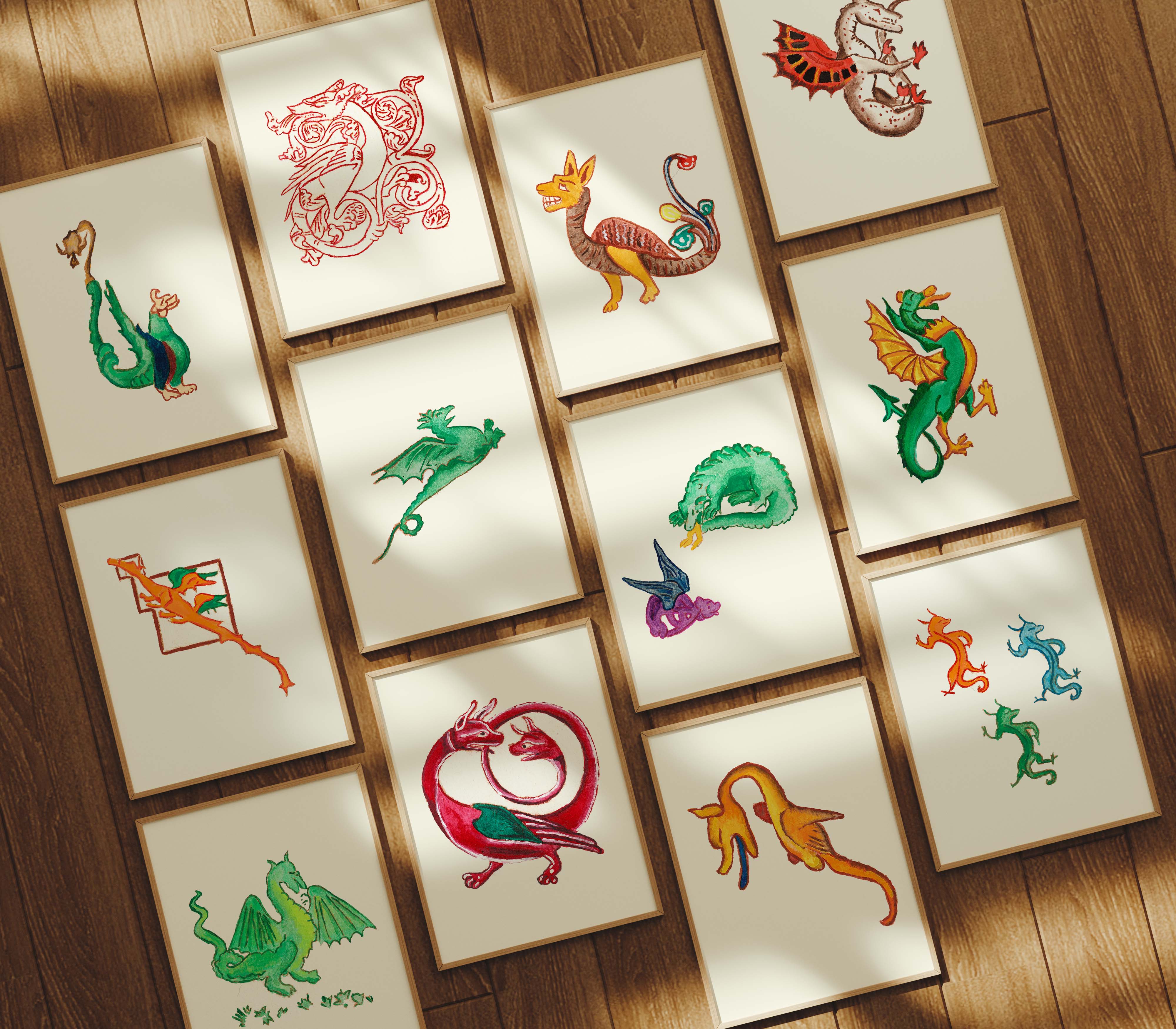
If you want a ready-made start, the Medieval Dragon Collection Fine Art Prints Set gives you a coordinated group of dragon prints.
Measure your wall before you buy, and check the frame size against the print size.
Frequently Asked Questions
How do I decorate a room with medieval folklore themes without it feeling cluttered?
Pick one folklore story or creature family as the anchor, then limit yourself to three to five related pieces, such as a framed print, a textured throw and a wooden tray. Repeat one or two colors across the room so the objects read as a set rather than a pile. Leave open wall space and some bare surfaces so each piece has room to be noticed. Many people find that removing one item from a shelf improves the room more than adding another.
How can I make medieval-inspired home decor feel modern?
Combine medieval pieces with clean, current furniture and neutral walls. A linen sofa or a simple metal lamp next to a woven tapestry-style blanket keeps the look comfortable rather than like a museum. Use warm lighting, avoid heavy drapery across every window, and limit yourself to one or two dramatic statement pieces. Modern comfort and medieval atmosphere work best when one side is kept deliberately quiet.
What colors and materials work well for medieval-themed reading room decor?
Deep green, oxblood, ochre, and aged stone gray work well, usually balanced with cream or unbleached linen. Wood with a visible grain, wool, cotton and velvet add texture without needing many objects. For a reading room, a woven throw and a bookmark set on a side table add story and warmth.
Can I decorate with medieval folklore themes on a small budget or as a renter?
Yes. Start with one folklore print, such as the Three Dancing Dragons Fine Art Print at $12.00, and add the Moonlit Castle Bookmark Set at $25.00 to a shelf or nightstand. Adding pieces gradually lets you build a collection over time instead of buying a full theme at once.
